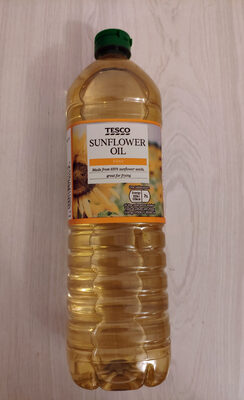
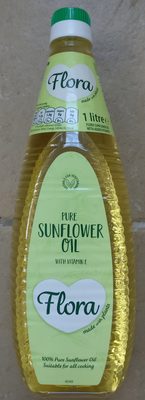
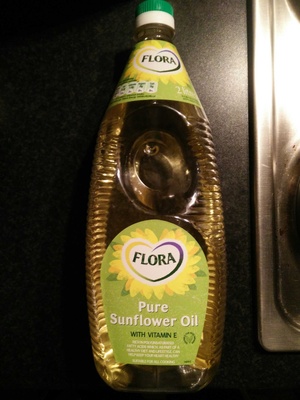
Sunflower oil
Carried in 22% of Iceland's products. Most often listed in frozen roasted french fries (100% of products in that category list it).
Sunflower oil · health claims, ranked by evidence
Sunflower oil is a common refined vegetable oil used because it is cheap, neutral-tasting, and useful in frying, baking, dressings, and packaged foods. The evidence does not support a simple 'bad for you' verdict. What matters most is what it replaces in the diet, whether it is regular high-linoleic or high-oleic, and how aggressively it is heated and reused.
This is the biggest online fear around regular sunflower oil, which is rich in linoleic acid. The mechanism sounds plausible on paper, but human trial evidence is less dramatic than the rhetoric. Meta-analyses of randomized trials that increase linoleic acid intake generally do not find consistent rises in CRP, IL-6, or similar inflammatory markers. That does not prove every seed-oil-heavy diet is harmless, because many trials test fat substitution under controlled conditions rather than ultra-processed, high-calorie diets. Best reading: the inflammation claim is possible in theory, but not clearly demonstrated in humans at typical intakes.
When sunflower oil replaces fats richer in saturated fat, such as butter or some tropical oils, controlled feeding studies generally show lower LDL and non-HDL cholesterol. That fits the wider trial literature on replacing saturated fat with polyunsaturated fat. The important qualifier is substitution: this is not the same as proving sunflower oil is a stand-alone health food, and it is not a reason to add extra oil to an already calorie-dense diet. Most sunflower-specific studies are short and measure blood lipids rather than long-term clinical events, so the most defensible claim is about risk markers, not guaranteed outcome benefits.
The current human evidence does not justify a blanket claim that sunflower oil is harmful simply because it is a seed oil or because it is refined. Refining can reduce antioxidants and flavor compounds, but it also removes impurities and makes the oil more neutral and shelf-stable. The real questions are fatty-acid profile, dose, cooking method, and the diet surrounding it. Internet discourse often bundles regular sunflower oil, high-oleic sunflower oil, repeated deep-frying, and ultra-processed foods into one category and treats that as proof. That is a stronger conclusion than the evidence supports.
This distinction matters and is often missed. Regular sunflower oil is typically high in linoleic acid, while high-oleic sunflower oil is richer in monounsaturated oleic acid. Frying and stability studies consistently find that high-oleic versions resist oxidative breakdown better and form fewer degradation products over time than regular sunflower oil under comparable heat. That is a cooking-performance claim, not direct proof of better long-term health outcomes, because most of this literature measures peroxides, aldehydes, and polymers rather than disease endpoints. Still, if you cook hotter or fry more often, high-oleic is the less fragile form.
Concern becomes more evidence-based when sunflower oil is kept hot for long periods or reused for repeated frying cycles. Food-science studies consistently show rising peroxide values, aldehydes, polymers, and other oxidation markers as heating time increases, with worse deterioration when oil is reused rather than fresh. The chemistry here is stronger than the clinical-outcome evidence, so it would be too strong to claim a precise disease effect from normal use. But the practical takeaway is fair: fresh oil used once for ordinary cooking is a different exposure from takeaway-style or habitual repeated deep-frying in the same oil.
Harsh heating can create small amounts of trans isomers and other breakdown products, but this is not the same as the old industrial trans-fat problem from partially hydrogenated oils. Typical home cooking does not appear to create trans-fat exposures remotely comparable to those older food supplies. The more evidence-based concern with sunflower oil is oxidative deterioration during prolonged, repeated, high-temperature frying, especially for regular high-linoleic oil. So the claim that ordinary cooking turns sunflower oil into a major trans-fat source is an overstatement, even if overheated oil is still not something to romanticize.
This is the most useful reality check. Trial evidence across dietary patterns and fat-substitution studies shows health outcomes depend more on what a fat replaces and on overall diet quality than on whether one ingredient gets labelled 'clean' or 'toxic'. Replacing saturated fat with unsaturated fats can improve lipid markers, but a diet heavy in excess calories, ultra-processed foods, and repeated deep-fried meals can still be poor even if the oil is sunflower. Sunflower oil is not a magic health food, but it is also rarely the main driver of risk by itself. Pattern beats purity most of the time.
- Check the label: regular sunflower oil and high-oleic sunflower oil are not equivalent for high-heat cooking stability.
- Repeated deep-frying or reusing the same oil is the scenario where concern increases most; ordinary fresh-use cooking is a different exposure.
- Store tightly closed, away from light and heat, because oxidation starts in the bottle as well as in the pan.
- Sunflower oil is calorie-dense like any cooking fat; evidence is most favorable when it replaces less favorable fats rather than being added on top.
This is editorial summary, not medical advice. If you have cardiovascular disease, lipid disorders, digestive conditions, or are making therapeutic diet changes, speak to a qualified clinician or registered dietitian before treating any single ingredient as the answer.Last hand-reviewed: 2026-05-01